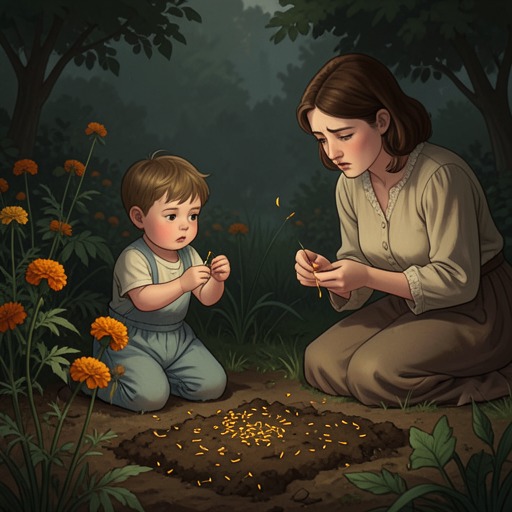
Certain seeds it will not nurture
The Bluest Eye“Certain seeds it will not nurture” is the closing image through which the narrator connects Pecola’s fate to the conditions that surrounded her. The metaphor begins with the failed marigolds and widens into an indictment of a community and country that failed to nurture her; its decisive force lies in refusing to treat the victim’s suffering as proof that she had no right to live.
The image and its immediate context
The narrator recalls seeing Pecola searching through garbage and asks what she is looking for: perhaps the thing “we assassinated.” The search gives the metaphor a human consequence. The flowers’ failure and Pecola’s condition are joined not because the soil is a decorative backdrop, but because the narrator makes the land part of an account of what the community did and failed to do.
The narrator first considers whether the seeds were planted too deeply, then shifts blame from that act to the earth, the land, and the town. The explanation keeps changing scale. What might have been a small mistake in planting becomes a question about the conditions in which anything vulnerable can grow, and about the responsibility of those who live within those conditions.
From local ground to national failure
The narrator extends the claim beyond the town, imagining that the land of the entire country was hostile to marigolds that year. This widening movement makes the soil more than a local circumstance: it becomes a figure for an environment that cannot sustain certain kinds of life. The line “This soil is bad for certain kinds of flowers” states the problem plainly, while the subsequent image of seeds that will not be nurtured turns the observation into a judgment about selective failure.
The metaphor does not suggest that every seed must flourish, or that nature can be made to guarantee an outcome. Rather, it asks what it means when the conditions of growth are hostile to particular lives. By moving from flowers to fruit and then to a victim denied the right to live, the narrator exposes the moral evasion in treating a failed life as its own explanation.
Responsibility and the language of victimhood
The closing reflection acknowledges how readily people accept the land’s apparent verdict: when it kills of its own volition, “we acquiesce and say the victim had no right to live.” The phrase turns passive acceptance into a collective act. Even when the narrator has tried to blame soil, weather, or place, the pronoun “we” restores human responsibility; the community’s failure cannot be made harmless by calling it natural.
The narrator explicitly admits that this judgment is wrong, but insists that recognizing the error does not undo its consequences. The belated understanding is therefore not a rescue or correction within Pecola’s life. It is an acknowledgment that the community’s explanations have helped conceal its complicity, arriving only after the damage has become irreversible.
The town’s landscape and the final emphasis
The ending returns to the edge of the town, where garbage and sunflowers mark the place from which the narrator speaks. This concrete setting binds the closing reflection to the earlier image of Pecola searching through waste, rather than allowing the metaphor to resolve into a detached moral. The landscape contains both neglect and growth, but the surviving flowers do not cancel what the soil failed to nurture.
The narrator’s repeated insistence that it is “too late” closes the image without offering consolation. The seeds’ failure stands for the particular lives and possibilities a hostile environment leaves unsupported; Pecola’s fate remains the measure of that failure. In this final formulation, the land’s apparent barrenness and the community’s moral acquiescence converge: what has not been nurtured is not thereby undeserving of life.